Duration of Status Updates
Fixed Period of Stay in the U.S. (Elimination of Duration of Status D/S)
What you need to know:
- On July 17, 2026, the U.S. Department of Homeland Security (DHS) issued a final rule entitled, Establishing a Fixed Time Period of Admission and an Extension of Stay Procedure for Nonimmigrant Academic Students, Exchange Visitors, and Representatives of Foreign Information Media. Once the final rule takes effect, it will eliminate “duration of status (D/S)” on the Form I-94 Admit Until Date (AUD) and will replace it with a fixed period of stay that admits all students and scholars on F-1 and J-1 visas up until an exact date. In most cases, the Admit Until Date (AUD) on an individual’s Form I-94 will coincide with the program end date noted on the Form I-20 or DS-2019, or a maximum period of four years, whichever is shorter. Students and scholars needing more than four years to complete their program objectives will need to file an extension application through USCIS after the rule takes effect. *The final rule goes into effect on September 15, 2026.
Effective September 15, 2026, the following changes will apply to F-1 students and J-1 exchange visitors – Please read carefully:
- Fixed “Admit Until Date (AUD)” on the I‑94– The I‑94 will list a specific departure date, called the Admit Until Date (AUD), when you enter the U.S. In most cases, the AUD will coorelate to the program end date on the Form I‑20 or DS‑2019, or a maximum period of four years, whichever is shorter. The AUD is inclusive of a 30-day departure period.
- Maximum stay of four years – In most cases, the I-94 Admit Until Date (AUD) will not exceed four years, even if the program end date listed on the I-20 or DS-2019 is later.
- Formal Extension of Stay (EOS) application with USCIS – Anyone needing additional time extending beyond their I-94 Admit Until Date (AUD) to complete their program, or to utilize post-completion employment benefits (e.g., OPT, STEM OPT, Academic Training) will have to file a formal Extension of Stay (EOS) application with U.S. Citizenship and Immigration Services (USCIS), which will incur additional fees for the student or scholar, as required by USCIS.
- Reduced grace period for F-1 students – the F-1 student grace period will be reduced from 60 to 30 days You will need to depart at this time. The J-1 student grace period remains at 30 days.
- Restrictions on program transfers –
- Undergraduate F-1 and J-1 students may not transfer to a different U.S. institution during their first year of study.
- Graduate F-1 and J-1 students may not transfer to a different U.S. institution during their program of study.
- J-1 Scholars – There are no restrictions on transferring institutions.
- Important Restrictions on changes to field of study/major –
- Undergraduate F-1 and J-1 students may not change majors in their first year of study.
- Graduate F-1 or J-1 students may not change programs/field of study at any point during their program of study.
The final rule was published in the Federal Register on Friday, July 17, 2026. The final rule goes into effect on Tuesday, September 15, 2026. Until then, current D/S policies remain in effect.
What can you do now?
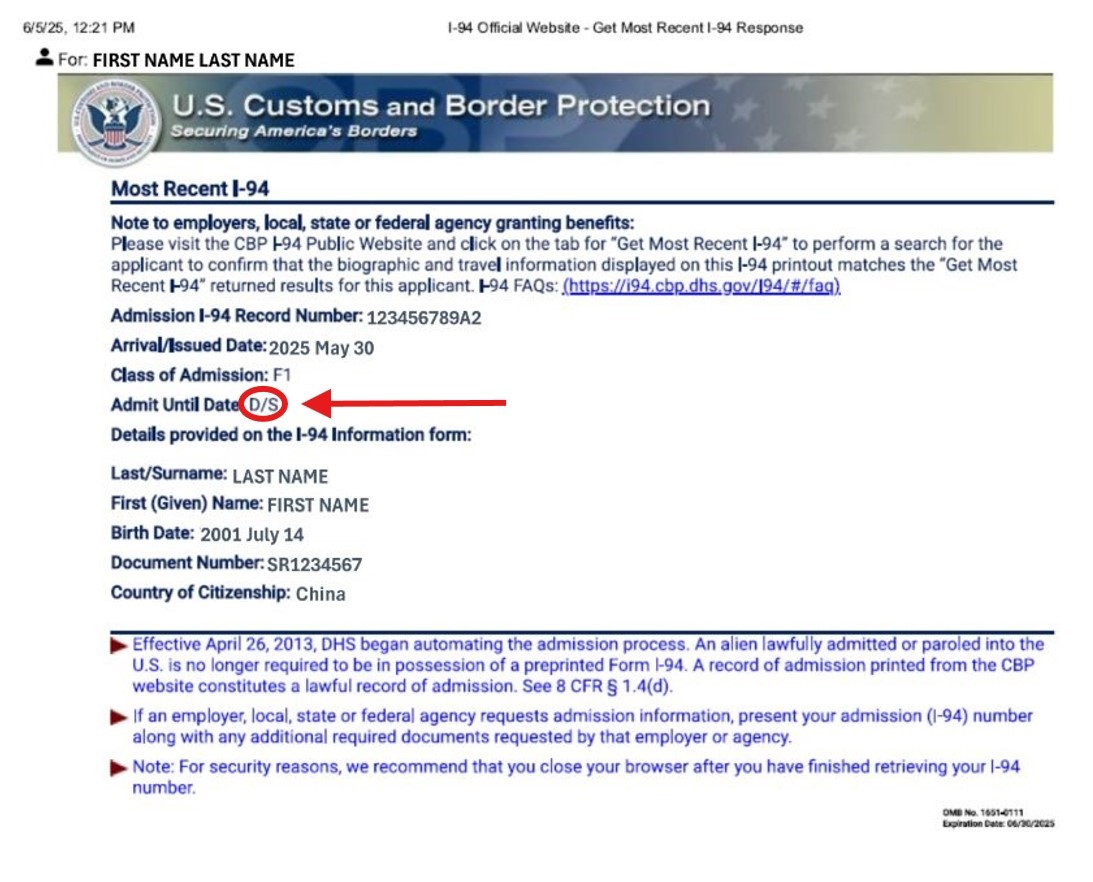
Familiarize yourself with your I-94 – You can access your Form I-94 on the official government website. Right now, the I‑94 for most F‑1 and J‑1 visa holders shows “D/S” (Duration of Status) in the Admit Until Date field. Effective September 15, 2026, the D/S policy will be eliminated, and any F-1 and J-1 visa holders entering the U.S. after this date will show a fixed date in this field:
Check your passport expiration date – Federal regulations require your passport to remain valid at least 6 months into the future when in the U.S. If your passport expires before the Admit Until Date on your I-94, your authorized stay in the U.S. is effectively limited to that expiration date, and you could fall out of status. Plan accordingly and renew if needed.