
An interesting thing happens whenever Justin Capin ’26 works a shift at the Center for Urban Research in Agriculture Hydroponic Farm on the first floor of the Mac Mahon Student Center. People passing by can’t help but notice the greenery growing inside the glass-walled lab called CURA Farm. Curious, they knock on the door and ask, “What is this place?”
“People are always intrigued,” said Capin, a double major in environmental and computer science. He and other CURA Farm
team members welcome the interest. Since 2022, the small lab that grows and distributes hundreds of edible plants each year has been a hub for research, sustainability, career preparation and service to the community.
A Sustainable Way to Farm
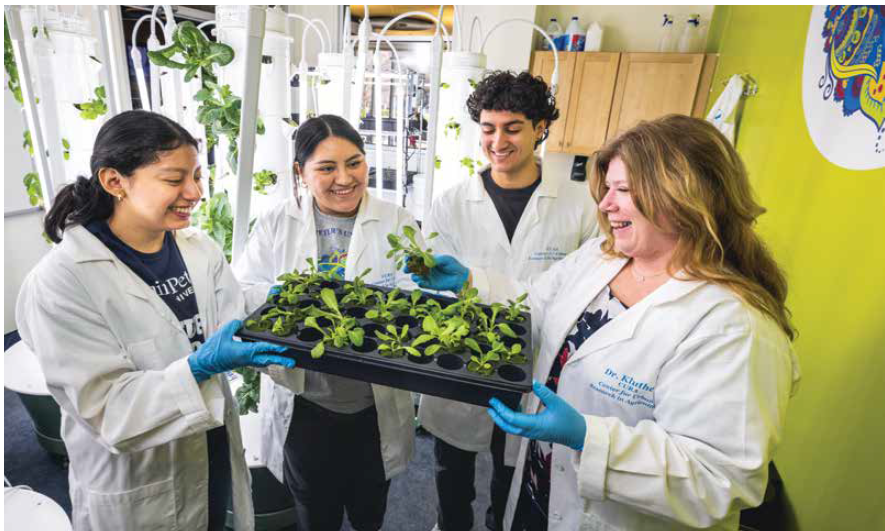 Hydroponics, a plant-growing method utilizing soilless cultivation and nutrient-rich water, dates to the ancient Hanging Gardens of Babylon. In the current century of climate change, it’s a way to produce certain crops 30 to 50 percent faster using 90 percent less water and land. Dr. Garrett-Kluthe introduced hydroponics in 2020 when the University’s SURGE summer camp was held virtually during COVID-19. “I had to get creative,” she recalled. Homemade hydroponic kits were distributed to high schoolers enrolled in the STEM camp. The program was so well received, the biology professor pitched a hydroponics lab to be one of two innovation hubs developed as part of the federal $4.8 million STEM-PODER grant awarded to the University in 2021.
Native Medicinal Plant Study is Born
The research opportunities the University envisioned for its students quickly emerged once CURA Farm opened. The most
prominent is a two-year research study on native medicinal plants conducted by Saint Peter’s undergraduates. The study’s
inquiry, “Are immigrant populations in Jersey City losing knowledge of indigenous and medicinal plant knowledge from their countries of origin?” was prompted by an earlier paper on food sovereignty.
A new group of undergraduate researchers took the food sovereignty study a step further. In 2023, GiannaMaria Guido ’24,
Maraya Cruz ’25, Junanyelis Flores ’24 and Capin were named Kesselman Student Fellows for the Advancement of Democracy by Engage NJ, an initiative that empowers teams of students across New Jersey to work on community projects that remove barriers to opportunity. “Many of us [involved in CURA Farm] are biology majors,” said Cruz. “We all want to go into medical fields, so I think it inspired us to look at herbal plants and medicine.”
Serving the Community
Food grown inside CURA Farm is given away to the Campus Kitchen Food Pantry and the campus community. The current
team, Cruz, Saldana and Capin, organized outreach events for Earth Week, recruiting volunteers to harvest and then distribute plants in McGinley Square and for Green Out Day on campus. The academic and service components of the project have encouraged growth in other areas as well.
CURA Farm, meanwhile, has become a sustainable student run operation. “It’s at the point where I come in to check on
things or troubleshoot,” said Dr. Garrett-Kluthe. Even at a training session for the new cohort in March, the professor’s only role was introductions and ice breakers. The students, including Guido, a member of the original cohort and now a graduate student in health sciences, ran the entire process.
No doubt the next group will make the most of the career and life-building opportunities that grow from CURA Farm. “This is open to everyone,” said Capin, who plans to remain involved in the hydroponics lab his senior year. STEM students, liberal arts majors and community members interested in making a positive impact on the community are all welcome. He added, “We want more people here to learn about urban agriculture and to have opportunities to do research and gain hands-on experience.”
Read the full story in the Summer 2025 issue of Saint Peter’s Magazine